Speakers - TUTO Bio: Evelina Colacino is Associate Professor of Organic and Green Chemistry at the University of Montpellier (France). She promotes sustainability in Higher Education by integrating green chemistry and mechanochemistry at undergraduate level in organic chemistry courses, teaching laboratories and across the sub-disciplines of chemistry (at national and international level). Her main research activities concern the development of eco-friendly mechanochemical processes for the preparation of value-added compounds for the industry, mainly focusing on Active Pharmaceutical Ingredients. Member of the International Mechanochemical Association (IMA), she chaired the European Programme COST Action CA18112 (MechSustInd, 2019-2023) ‘Mechanochemistry for Sustainable Industry' and she currently coordinates the Horizon Europe Project IMPACTIVE (2022-2026) (for Innovative Mechanochemical Processes to synthesize green ACTIVE pharmaceutical ingredients) and the IUPAC Task Group on ‘Terminology and Symbolism for Mechanochemistry’. In 2024, she spearheaded the establishment of the EuChemS Professional Network on Mechanochemistry, that she is leading as Chair since January 2025. Sujet: Sustainable preparation of World Health Organisation (WHO) essential medicines by mechanochemistry Although significant efforts have been made to reduce the environmental impact of active pharmaceutical ingredient (API) production, the use of organic solvents—responsible for about 75% of the total energy consumption—remains a critical step in many processes. Solvent-free synthesis through mechanochemistry aligns with several of the 12 Principles of Green Chemistry, offering a more environmentally responsible alternative for chemical synthesis. This presentation explores the application of mechanochemical methods to the preparation of World Health Organization (WHO) essential medicines at various scales. Using green chemistry metrics, we evaluate the environmental and economic benefits of mechanochemistry, demonstrating its potential to advance greener and more sustainable pharmaceutical manufacturing. Ultimately, these studies highlight mechanochemistry as a key enabler in the transition toward a more sustainable and resilient chemical industry.
Bio: Gaël Schaeffer earned his PhD in supramolecular chemistry at the University of Strasbourg, advised by Prof. Jean-Marie Lehn. He then joined the University of Groningen as postdoctoral research with Prof. Sijbren Otto, researching self-replicating systems and synthetic life. Since 2018, he has served as Scientific Coordinator at the Stratingh Institute for Chemistry at the same university. In 2022, he also took on the role of chairing the faculty’s Green Labs initiative, focusing on reducing the environmental footprint of research activities. Topic: Green Labs: towards sustainable research practices Researchers worldwide focus on climate solutions but often ignore academia’s own environmental impact. Each University of Groningen researcher emits 10–37 tons of CO₂e annually, far above the Paris Agreement’s 1.5-ton target. Globally, 8.8 million researchers emit 385+ megatons of CO₂e yearly, rivaling major countries, and produce 5.5 million tons of lab plastic waste (2% of global plastic waste). Groningen’s Green Labs team leads change: creating a widely used sustainability guidebook, influencing EU policies, recycling lab plastics, certifying 100+ labs via LEAF, and piloting Green DiSC. Recognized by Nature and Chemistry & Engineering News, Groningen’s Faculty of Science and Engineering stands as a “Green Island” in sustainable research.
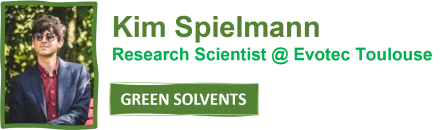
Bio: Kim Spielmann is a chemical engineer and pharmacist by training. He obtained his PhD in organic chemistry under the supervision of Pr. Jean-Marc Campagne and Dr. Renata Marcia de Figueiredo, focusing on the development of asymmetric methodologies and their application to the total synthesis of natural products. He then completed postdoctoral studies in the laboratory of Pr. Michael Krische at the University of Austin, where he worked on iridium and palladium catalysis. Following this, he spent a year at Sygnature Discovery in Nottingham. He is now a Research Scientist at Evotec. Topic: Sustainability and Green Chemistry at Evotec At Evotec, innovation and sustainability are at the heart of our scientific strategy. To remain at the forefront of technology, the green chemistry working group plays a vital role in designing safer, cleaner, and more sustainable chemical processes. The principles of green chemistry are applied throughout the entire product lifecycle: from the design of synthesis pathways to waste disposal. In this presentation, we will showcase various advancements implemented in our laboratories. Bio: Dr. Karine Loubière received her PhD diploma in chemical engineering from INSA Toulouse in 2002; her thesis about bubble formation at rigid and flexible orifices was awarded by SFGP in 2003. After two post-doctoral positions, she entered the laboratory GEPEA (Saint-Nazaire) in 2005 as CNRS junior researcher to work on design and modelling of advanced photoreactors for microalgal cultures. In 2009, she joined the department “Science and Technology for Process Intensification” of the Laboratoire de Génie Chimique (LGC, Toulouse). In 2016, she obtained her HDR from Toulouse INP. She became a CNRS senior researcher (DR) in 2017. Her present research mainly focuses on flow photochemistry engineering, but also on mass transfer across fluidic interfaces (in particular in confined geometries such as Taylor flows or thin-gap cells) and on dimensional analysis. Topic: Flow Photochemistry for Green Chemistry and Process Intensification. Photochemistry is now an essential synthetic route for green chemistry. Through photon absorption, it becomes possible to generate highly complex molecules in a single step and under mild conditions. Its industrial-scale implementation is generally achieved using batch reactors operating in a closed loop and irradiated by energy-intensive mercury lamps. The performance of these processes, whether kinetic or energetic, is inherently limited by radiation transfer. In this context, this tutorial will explain how continuous micro/millistructured LED-illuminated technologies are a promising alternative for low-tonnage photochemical applications (fine chemicals, pharmaceutical industry). Indeed, they offer selectivities and yields far superior to those obtained in conventional batch reactors thanks to several advantages: continuous operation, the small size of their channels (from hundreds of µm to mm) allowing for intensified transfer phenomena, the spectral selectivity of the LEDs, and the modularity of the radiant power they emit. Various examples of flux photochemistry will be presented as illustrations.
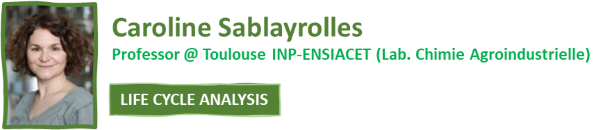
Bio: Caroline Sablayrolles, a chemical engineer (ENSCT, 2001), holds a PhD in Environmental Chemistry (2004) and a Habilitation to Supervise Research (HDR, 2014). She is a Full Professor at the National Polytechnic Institute of Toulouse. Since 2022, she has been Head of the Chemical Engineering degree program at Toulouse INP-ENSIACET, and since 2019, she has led the “Environmental Assessment and Ecodesign” research theme at the Laboratory of Agro-Industrial Chemistry. Following her doctoral research on the transfer of organic micropollutants in soil–plant systems, Caroline Sablayrolles has dedicated her research activities to the environmental impacts of human activities, within the methodological framework of Life Cycle Assessment (LCA). Her work focuses both on methodological development—from determining pollutant emissions and resource consumption to quantifying damage to ecosystems—and on the application of these approaches to the bioeconomy. Topic: An Environmental Evaluation and Ecodesign Method Supporting Green Chemistry Life Cycle Assessment (LCA) is a standardized evaluation method (ISO 14040–14044) used to quantify the environmental and health impacts of a product, process, or service throughout its entire life cycle. This methodology can support researchers in developing molecules, processes, and materials that are more resource-efficient and more respectful of both human health and the environment. It helps provide an objective basis for technological choices, compare alternative options, prevent burden shifting (between life cycle stages and impact categories), and guide innovation toward genuinely more sustainable solutions. This tutorial will provide an overview of the LCA methodology and present its four main phases in detail. The research approach developed within the laboratory will then be introduced and illustrated through several doctoral research examples involving ecodesign, defossilization strategies, and continuous improvement initiatives.
|